Your browser does not support JavaScript!

Automated harvesting of cells eliminates laborious steps when manually harvesting cells from a system. Different Tide Motion bioreactors are each equipped with its own harvesting system. The harvesting process uses the same conventional method of harvesting adherent cells.

CelCradle® X Automated Cell Harvesting System

The Cradle's Harvester Partner

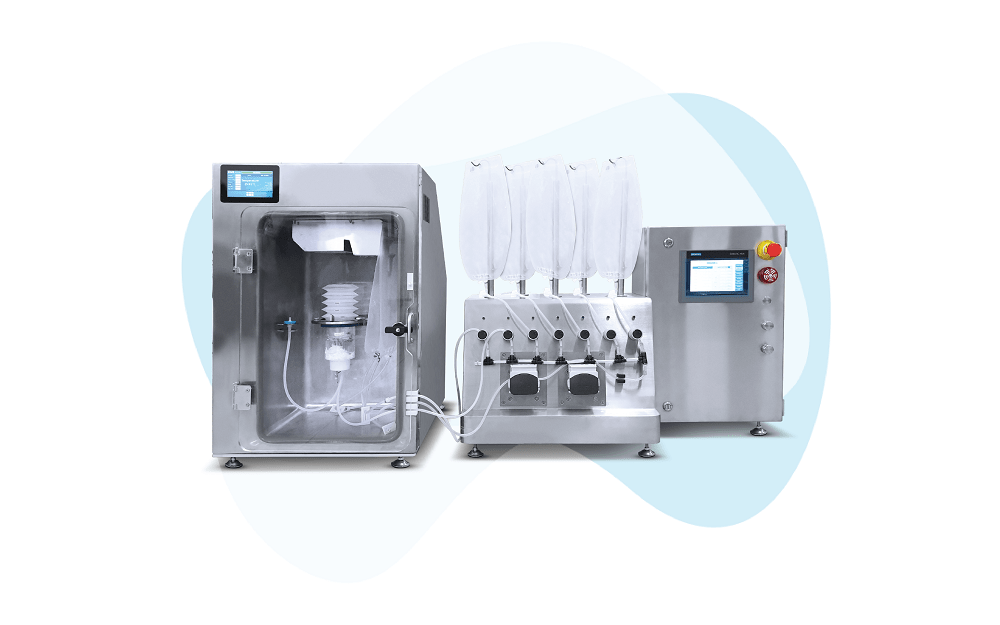
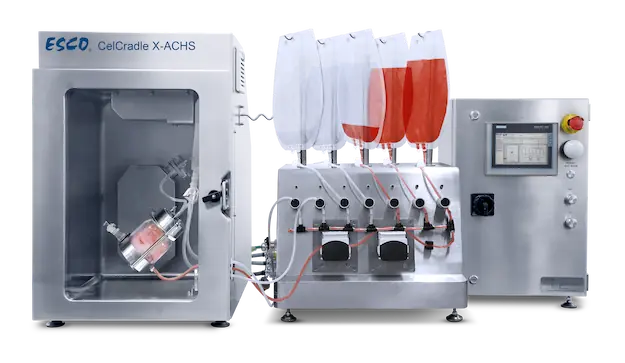
The CelCradle® X – Automated Cell Harvesting System (CelCradle X® ACHS) is designed to provide a closed and automated solution for harvesting adherent cells from CelCradle® X and CelCradle® bioreactors.

By standardizing the cell harvesting process, ACHS eliminates labor-intensive manual operations and ensures consistent, efficient, and reproducible cell recovery.

Optimized for gentle harvesting from TideMotion bioreactors, the system maximizes cell yield while maintaining high cell viability. In addition, the patented harvesting technology can be configured to support adherent microcarriers in suspension bioreactors and other packed-bed culture systems.
Request for Quotation
CelCradle X<sup>®</sup> Semi-Automated Harvester
Tide Technology Features

Features

  • Single-use harvest assembly kit for closed, automated harvesting 
  • Harvest viable cells within 1-3 hours 
  • Heating incubator for harvest procedures that requires 20°C to 40°C
  • Achieve >90% harvesting efficiency  

Note: Harvesting efficiency will be dependent on the cell line used, media or enzyme used, process, etc. 

Applications

The CelCradle X® ACHS supports a wide range of applications across research, development, and industrial manufacturing, including: 

  • Adherent Cell Therapy Manufacturing – Automated harvesting of autologous and allogeneic MSCs and other adherent cell types ; harvesting adherent cells for cell derivatives such as cell derived nanovesicles, mitochondria, etc. 
  • Seed Train Expansion – Biomass production for larger packed-bed or suspension bioreactors. 
  • Process Development and Scale-Up – Ideal for optimizing harvest parameters, reducing variability, and validating GMP-ready processes. 
  • Ability to be configured for harvesting cells from microcarriers

Tide Technology Applications

The CelCradle X® ACHS leverages automation, flexibility, and process integrity to streamline downstream workflows. This reduces manual labour and provides a faster, more reliable path to commercial biomanufacturing scale.

CelCradle X<sup>®</sup> Semi-Automated Harvester product 1 CelCradle X<sup>®</sup> Semi-Automated Harvester product 1 with label

Workflow

  1. Set the harvesting conditions (e.g., chamber temperature).
  2. Configure the harvesting recipe (washing, enzyme incubation, shaking, harvest,etc.)
  3. Prepare reagents and buffers and fill them into single-use bags.
  4. Install the consumables kit onto the system.
  5. Place the CelCradle® or CelCradle X® vessel onto the holder.
  6. Start the automated harvesting process.

Parameters

  • Pump speed
  • Shaking speed
  • Duration of shaking/Delay per Step
  • Harvesting cycles

Harvesting Recipe:

  1. Removal of Culture Medium/Waste

    • Existing medium or waste is pumped out of the vessel to initiate the harvest process.

  2. Washing

    • Add phosphate-buffered saline (PBS) or ethylenediaminetetraacetic acid (EDTA).
    • The shaking motor generates a gentle vertical oscillation on the bottle.
    • The wash solution is then pumped out.

  3. Enzyme Incubation 

    • A dissociating reagent is pumped into the vessel.
    • The rotating mechanism distributes it evenly.
    • Incubation time is set according to optimized conditions.
    • Common enzymes include recombinant trypsin, collagenase, accutase, papain, etc.

  1. Inhibitor Addition (Optional)

    • An enzyme inhibitor may be pumped into the vessel if required.

  2. Mechanical Shaking

    • The system automatically performs vertical shaking of the vessel to further detach cells from the carriers.

  3. Medium Addition

    • Culture medium containing serum or trypsin inhibitor is pumped in to flush the cells.

  4. Collection

    • The suspension containing cells is collected into the harvest bag.

  5. Repetition

    • Steps 5-6 are repeated five times to maximize yield.
    • Cells are fully harvested from carriers then obtained via centrifuge.

Note: Users are responsible for ensuring au reagents and liquids are sterile and must follow proper aseptic connection procedures.

Frequently Asked Questions

How Does It Work?

The harvesting duration depends on the inputted harvest cycles. Run usually takes 1 to 3 hours.
Yes, recipes and alarms are recorded with date and time stamps.
AsterZyme, an optimized enzyme developed in-house (as the cell harvester manufacturer) for harvesting mesenchymal stem cells (MSCs) that has been demonstrated to achieve 90% harvest efficiency.
es, the HMI can control both incubator and main SAH unit with pumps.
Adherent cells such as insect, mammalian, and stem cells are among the cells applicable for harvest using the system.
The CCX-SAH can accommodate 1 CelCradle 0.5ml bottle.

Product Specification

CelCradle® X - Automated Cell Harvesting System (CCX – ACHS)

Exterior dimension (WxDxH) Incubation Chamber 50.0(W) x 64.6(D) x 76.9(H) cm  
Harvester pumping set and HMI Box: 92.8(W) x 38.2(D) x 82.2(H) cm 
Weight 200 kg
Power Single phase, AC, 220-240 V, 50/60 Hz
Motor Shaker motor
Max Speed range 50 – 200 rpm
Tubing 3/16’ silicone tubing
Capacity 1 CelCradle bottle
Consumable CelCradle Bottle Volume 500 ml
CelCradle Material PP
Incubator temperature range Range: 20℃ – 40℃ At room temperature 18℃ to 25℃  
Accuracy: ±0.5℃. 
Touchscreen Size Input interface: Siemens 7’ color HMI 
Operating module: Siemens PLC 
Stay Updated!

Sign up to our newsletter and receive the latest news and updates about our products!

Lab Image